
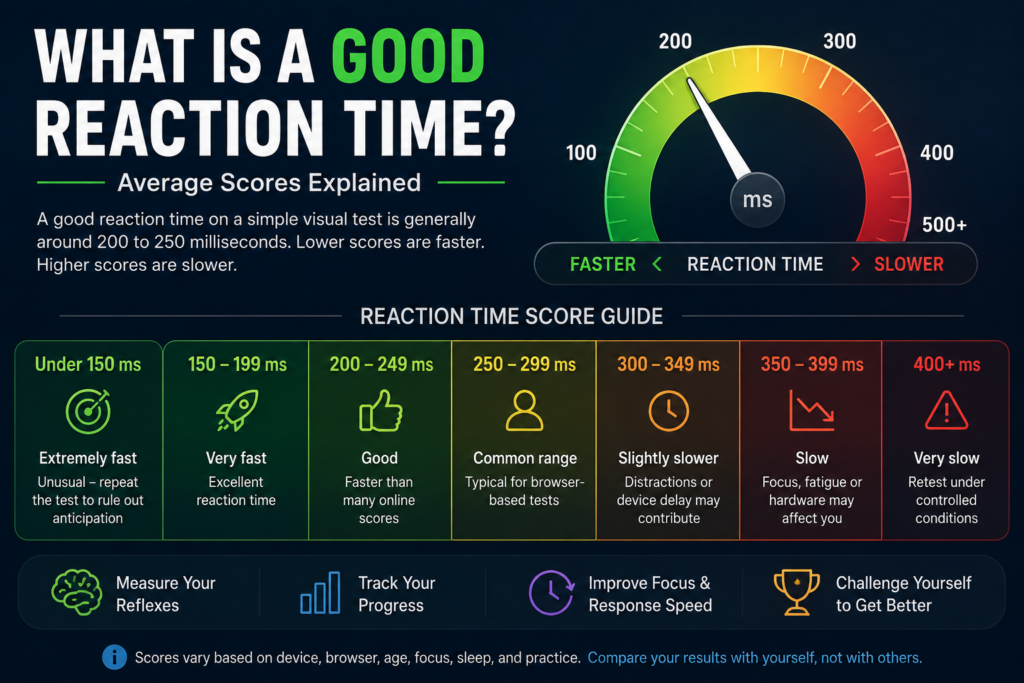
A good reaction time on a simple visual test is generally considered to be around 200 to 250 milliseconds. Results below 200 milliseconds are usually considered very fast, while scores between 250 and 300 milliseconds are common on browser-based reaction time tests.
However, there is no single score that is “good” for everyone. Your result can change depending on your age, focus, sleep, practice, monitor, mouse, touchscreen, browser, and the type of reaction task you complete.
A browser test also measures more than your biological response. The displayed result can include small delays caused by your screen, operating system, browser, and input device.
For this reason, your score is most useful when you compare it with your own previous results under similar testing conditions.
Quick answer: A reaction time between 200 and 250 ms is generally fast for a simple visual browser test. A score between 250 and 300 ms is still common, especially when normal hardware and browser delays are included.
Reaction Time Score Guide
The following ranges provide a practical way to interpret results from a simple visual test in which you click or tap when the screen changes color.
| Reaction time | General interpretation |
|---|---|
| Under 150 ms | Extremely fast; repeat the test to rule out anticipation |
| 150–199 ms | Very fast |
| 200–249 ms | Good and faster than many online scores |
| 250–299 ms | Common range for browser-based tests |
| 300–349 ms | Slightly slower than the common online range |
| 350–399 ms | Slow result; distractions or device delay may contribute |
| 400 ms or more | Retest under controlled conditions |
These are general interpretation ranges rather than medical or clinical standards. Reaction-time results vary substantially between test designs, devices, and participants.
A large calibrated study involving 1,469 adults reported a mean simple visual reaction time of approximately 231 ms before correcting for hardware delays and 213 ms after correction. In comparison, Human Benchmark reports a median online score of approximately 273 ms and an average of approximately 284 ms, demonstrating how online hardware and test conditions can produce higher results.
What Is Reaction Time?
Reaction time is the delay between the appearance of a stimulus and the beginning of your response.
In a basic visual reaction test, the process usually looks like this:
- You wait for a testing area to change color.
- Your eyes detect the visual change.
- Your brain recognizes the signal.
- Your brain sends instructions to your hand.
- You click, tap, or press a key.
- The browser records the total time in milliseconds.
One millisecond is one-thousandth of a second. Therefore, a score of 250 ms is equal to one-quarter of a second.
The test available on our homepage is mainly a simple visual reaction-time test. You know which signal will appear and which response you need to make. You are not required to choose between several possible actions.
More complicated tasks, such as selecting the correct key for a specific color, normally require additional processing and should not be compared directly with simple visual results. A study comparing task types found that simple, choice and go/no-go reaction tasks can produce different results because more complex tasks require decision-making or response inhibition.
What Is the Average Human Reaction Time?
The average human reaction time depends on how the test is designed and measured.
In controlled or calibrated simple visual tests, many adult results fall approximately within the 200–250 ms range. Online browser tests often produce results closer to 250–300 ms because they include additional hardware and software delays.
For example:
- A calibrated study of adults reported an average simple reaction time of about 231 ms before hardware correction.
- Another study involving 120 participants reported a mean visual simple reaction time of approximately 299 ms.
- Human Benchmark’s online statistics show a median of approximately 273 ms and an average of approximately 284 ms.
These figures are not contradictory. They show that reaction time cannot be represented by one universal number. Different stimuli, devices, testing methods, participant groups, and timing systems can produce different averages.
Controlled tests vs online tests
A laboratory may use calibrated equipment designed to reduce display and input delay. A typical website must work across many combinations of:
- Monitors
- Smartphones
- Tablets
- Mice
- Touchscreens
- Keyboards
- Browsers
- Operating systems
Research examining modern online testing platforms found that web-based tools can provide reasonable timing accuracy, but results can still vary across browsers, devices, and hardware configurations.
An online test is therefore best used for:
- Casual performance measurement
- Comparing repeated attempts
- Tracking personal progress
- Practising attention and response speed
- Comparing sessions on the same device
It should not be treated as a medical, neurological, employment, driving or professional fitness assessment.
Is 200 ms a Good Reaction Time?
Yes. A reaction time of 200 milliseconds is a good result on a simple visual browser test.
A consistent average around 200 ms generally indicates a fast response to a predictable visual signal. It is especially strong if the result is based on several valid attempts rather than one unusually fast click.
However, a single 200 ms attempt does not necessarily represent your normal performance. Your best result may be significantly faster than your average or median.
For example, consider these five attempts:
| Attempt | Result |
| 1 | 241 ms |
| 2 | 203 ms |
| 3 | 226 ms |
| 4 | 215 ms |
| 5 | 229 ms |
The best result is 203 ms, but the average is approximately 223 ms. The average provides a more balanced summary of the full session.
Is a Reaction Time Below 150 ms Possible?
A score below 150 ms can appear on an online reaction test, but it should be interpreted carefully.
An extremely low score may occur because:
- The user anticipated the signal.
- The user clicked as the color changed by chance.
- The timer began later than the visible change.
- The browser or device handled the event unusually.
- The test did not properly reject early clicks.
- The user achieved a genuinely exceptional attempt.
A very fast score is more convincing when it can be repeated consistently across several valid attempts.
Do not rely on one unusually low result. Complete at least five attempts and compare your average, median, and consistency.
Is 300 ms a Bad Reaction Time?
No. A score of 300 ms is not automatically bad.
It may be slightly slower than commonly reported results for simple visual tests, but it can still be influenced by ordinary factors such as:
- Using a touchscreen
- Testing on a lower-refresh-rate display
- Feeling tired
- Losing concentration
- Using an unfamiliar device
- Running background applications
- Completing the test for the first time
- Waiting too cautiously to avoid a false start
A single 300 ms result does not describe your overall ability. Complete several attempts, remove distractions and compare your score with later sessions on the same device.
Reaction time also tends to become slower and more variable with age. A large study of 7,130 adults found that reaction times generally slowed and became more variable across adulthood. However, age is only one factor, and results from different tasks should not be compared as though they use one universal standard.
Average, Median or Best: Which Score Matters Most?
A complete reaction test may show several different statistics. Each one tells you something different about your performance.
Average reaction time
Your average is calculated by adding all valid attempts and dividing the total by the number of attempts.
For example:
220 + 245 + 230 + 218 + 237 = 1,150
1,150 ÷ 5 = 230 ms
The average uses every result, making it useful for summarizing your complete session. However, one unusually slow attempt can raise it.
Median reaction time
The median is the middle result after the attempts are arranged from fastest to slowest.
For these results:
218, 220, 230, 237, 245
The median is 230 ms.
The median is less affected by one unusually fast or slow attempt. It can provide a stable picture when your results include an outlier.
Best reaction time
Your best result is your fastest valid attempt.
It shows your peak performance during the session, but it does not necessarily represent your normal reaction speed.
Consistency
Consistency shows how closely your attempts are grouped.
A person who records:
228, 231, 226, 233, 229
is more consistent than a person who records:
180, 315, 245, 201, 340
even if their averages are similar.
For tracking progress, focus mainly on your:
- Average
- Median
- Consistency
- Results across multiple sessions
Use your best score as an additional performance highlight rather than your only benchmark.
Why Does My Reaction Time Score Change?
Reaction time naturally varies from one attempt to another. You are not expected to receive exactly the same result every time.
Several human and technical factors can influence your score.
Focus and attention
You may react faster when your attention is fully fixed on the testing area. Notifications, conversations, music or looking away from the screen can delay your response.
Sleep and tiredness
Poor sleep and physical fatigue may make it harder to notice and respond to the signal quickly.
Practice and familiarity
Your early attempts may be slower because you are still learning the test. After a few attempts, you may respond more smoothly because you know what to expect.
This is why the first attempt can be treated as practice when comparing serious sessions.
Stress and anticipation
Trying too hard to achieve an extremely fast score can cause premature clicks. A valid reaction should happen after the signal appears, not because you predicted when it would change.
Monitor refresh rate
A display updates its image at fixed intervals. A higher refresh rate can present a new frame sooner, although it does not automatically guarantee a faster human response.
Mouse and touchscreen latency
A mouse, keyboard or touchscreen takes a small amount of time to register and send your action to the browser.
Browser and operating-system performance
Open tabs, browser extensions, background applications and system load may add small timing differences.
Because these factors change between sessions, compare results using the same device, browser and testing conditions whenever possible.
Desktop vs Mobile Reaction Time
Your result may be different on a phone than on a desktop computer.
A desktop setup may involve:
- A physical mouse
- A high-refresh-rate monitor
- A faster processor
- Lower input latency
- A stable hand position
A mobile setup may involve:
- Touchscreen processing
- Finger movement
- Display scaling
- Browser interface changes
- Power-saving settings
- A different screen refresh rate
Neither result is automatically wrong. They were simply recorded under different conditions.
For a fair progress comparison, do not mix desktop and mobile results. Choose one device and continue testing on the same setup.
How Many Attempts Should You Complete?
Complete at least five valid attempts for a useful session result.
One attempt can be affected by:
- Surprise
- Distraction
- Anticipation
- Accidental movement
- Temporary browser delay
- Unfamiliarity with the test
Five attempts provide enough information to calculate an average, median, best result and basic consistency.
For more reliable personal tracking:
- Complete one unrecorded practice attempt.
- Complete five valid recorded attempts.
- Rest briefly before starting another session.
- Use the same device and browser.
- Compare session averages rather than individual clicks.
Completing dozens of attempts without a break may also introduce practice effects or fatigue, so more attempts are not always better.
How to Get a More Accurate Reaction Time Score
Follow these steps when testing your reaction time:
1. Use the same device
Do not compare a phone result directly with a desktop result. Hardware differences can affect the displayed score.
2. Close unnecessary applications
Heavy downloads, games, browser tabs, and background programs may use system resources.
3. Remove distractions
Turn off notifications and test in a quiet environment.
4. Position your hand comfortably
Keep your finger near the mouse button, screen, or response key without holding unnecessary tension.
5. Complete a practice attempt
Use the first attempt to understand the test rather than treating it as your main result.
6. Wait for the signal
Do not guess when the testing area will change. Early clicks should not count as valid results.
7. Complete five valid attempts
Use your average and median to understand the full session.
8. Retest under similar conditions
For meaningful comparisons, use the same browser, device, input method, and approximate testing environment.
Can You Improve Your Reaction Time?
Reaction-test performance can improve with familiarity, attention, and repeated practice, but improvement does not always mean your nervous system has permanently become faster.
Some early progress happens because you:
- Understand the test better
- Know where to focus
- Become more comfortable with the response
- Reduce unnecessary hand movement
- Avoid distractions
- Learn not to hesitate
Sleep, exercise, focus, and general wellbeing may also affect performance. However, claims of dramatic or guaranteed improvement should be treated carefully.
The fairest way to track progress is to record your baseline average and compare it with later sessions completed under the same conditions.
Does a Fast Reaction Time Make You Better at Gaming?
A fast, simple reaction time may be useful in gaming, but it is only one part of performance.
Most games require more than clicking when a color changes. Players may need to:
- Identify the target
- Select the correct action
- Control movement
- Aim accurately
- Predict an opponent
- Understand game patterns
- Make decisions under pressure
A player with a 220 ms simple reaction time is not automatically better than a player with a 260 ms result. Prediction, accuracy, positioning, knowledge, and decision-making may matter more than a small difference in raw response speed.
Use a browser reaction test as one performance indicator, not a complete measurement of gaming ability.
When Should You Be Concerned About Your Score?
A browser reaction test cannot diagnose a medical condition.
One slow session may be caused by tiredness, distraction, unfamiliar hardware or ordinary variation. Even repeated online scores should not be used to assess neurological health, driving safety, or professional fitness.
Consider speaking with a qualified healthcare professional when you experience a new or concerning real-life change, such as:
- Sudden difficulty responding to everyday events
- New weakness or loss of coordination
- Significant changes after an injury
- Symptoms that interfere with normal activities
Do not use an online score as a substitute for professional evaluation.
Test Your Reaction Time
The best way to understand your current result is to complete several valid attempts under controlled conditions.
Use our free Reaction Time Test to measure five attempts and review your:
- Average
- Median
- Best result
- Slowest result
- Attempt history
- Consistency
Complete the test using your usual device, then return later and compare your new session under similar conditions.
Frequently Asked Questions
What is considered a good reaction time?
A result between 200 and 250 ms is generally considered good for a simple visual browser test. Scores below 200 ms are very fast, while results between 250 and 300 ms are common online.
What is the average human reaction time?
The average depends on the test and equipment. Controlled simple visual studies often report results near 200–250 ms, while browser-based datasets may produce averages closer to 250–300 ms because hardware and software delays are included.
Is 200 ms a good reaction time?
Yes. A consistent average around 200 ms is a fast result on a simple visual test. It is more meaningful when calculated from several valid attempts.
Is 250 ms a good reaction time?
Yes. A 250 ms result falls within a common range for visual reaction-time tests and can be considered a normal-to-good browser result.
Is 300 ms reaction time slow?
A 300 ms score is somewhat slower than commonly cited simple visual averages, but it is not automatically poor. Device latency, tiredness, focus, and testing conditions may contribute.
Is a reaction time below 150 ms possible?
It is possible for an online test to display a result below 150 ms, but an isolated score may be caused by anticipation or timing variation. Repeat the test and review the full-session average.
Should I use my best or average score?
Use your average and median for a balanced view of your performance. Your best result represents your fastest attempt but may not reflect your typical response.
Why is my reaction time slower on mobile?
Touchscreen processing, display refresh rate, finger movement, and mobile browser performance can make a phone result different from a desktop result.
How many reaction-time attempts should I complete?
Complete at least five valid attempts. This provides enough results to calculate an average, median, best score, and consistency.
Can reaction time improve with practice?
Test performance may improve as you become familiar with the task and reduce hesitation. Sleep, focus, and repeated practice may also influence your results, but improvement differs between individuals.
Does age affect reaction time?
Research indicates that reaction time generally becomes slower and more variable across adulthood, although age is only one factor and individual results vary.
Is an online reaction test medically accurate?
No. An online reaction test is intended for casual measurement and personal comparison. It should not be used for medical diagnosis, driving assessment, employment screening, or professional fitness decisions.
Conclusion
A good reaction time on a simple visual browser test is generally around 200 to 250 milliseconds, while scores between 250 and 300 milliseconds remain common online.
Your result should always be interpreted in context. Age, attention, sleep, practice, monitor refresh rate, input device, and browser performance can all influence the number displayed on your screen.
Instead of judging yourself by one click, complete at least five valid attempts and focus on your average, median and consistency. For the fairest comparison, use the same device and repeat the test under similar conditions.
Most importantly, remember that a browser score is a casual performance measurement—not a medical assessment or a complete measurement of gaming, sporting or real-world ability.