
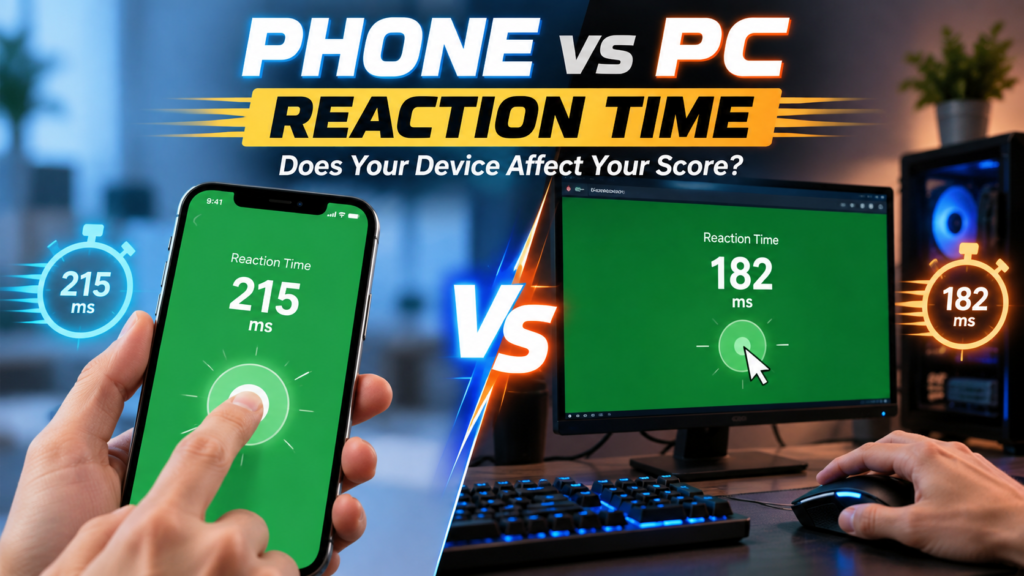
Have you ever taken a reaction time test on your phone and then received a different score on your PC? That difference does not automatically mean your reactions suddenly became faster or slower.
Your phone, computer, display, browser, and input method can all affect the number shown on an online test. If you want to compare your own results, start with our Reaction Time Test and use the same device for repeated sessions.
Can Your Device Affect Reaction Time Results?
Yes. An online reaction time score contains more than your biological response speed. The device must display the stimulus, detect your tap or click, and report that input back to the browser.
Research using large online samples has found measurable differences in reaction-time performance across device types. This means two scores from different devices should not always be treated as perfectly equivalent.
Phone vs PC Reaction Time
A phone normally uses a touchscreen, while a desktop PC commonly uses a mouse. These two input methods work differently and can introduce different amounts of delay into a reaction time measurement.
In one large web-based study, mobile users generally recorded slower performance on reaction-time tasks than laptop and desktop users. The researchers found that operating system, input type, and device characteristics could all contribute to measured differences.
Why Can Phone Scores Be Slower?
The difference is not simply because people react more slowly while holding a phone. Part of the result may come from the hardware and software involved in displaying and recording the response.
Common factors include:
- Touchscreen input latency
- Display refresh rate
- Operating system processing
- Browser timing
- Device performance
- Finger movement and tapping method
A controlled study of online cognitive tests found that input type had a significant effect on simple reaction-time performance, with mouse-operated devices producing faster measured responses than touchscreen devices in that comparison.
Touchscreen vs Mouse Reaction Time
A touchscreen records direct contact with the display, while a mouse sends its input through separate hardware. It may seem that touching the screen should always be faster because your finger is already near the target, but measurement is more complicated.
Different touchscreens and mice have different input delays. Research therefore suggests that the device and input method should be considered part of the test setup, rather than assuming every browser score is directly comparable.
Does This Mean a PC Is Always Faster?
No. It would be incorrect to say that every PC will always produce a faster score than every phone. Hardware quality, refresh rate, browser, mouse latency, touchscreen technology, and the individual user can all change the result.
Some studies using specific mobile testing systems have found reaction-time measurements that were reasonably consistent with traditional platforms. The exact result depends on the testing method and equipment being used.
How Big Can the Difference Be?
There is no universal number such as “phones add exactly 30 ms.” Device delay varies too much for a single correction value to work across every phone, monitor, touchscreen, mouse, and browser.
Research into web-based timing has also found that consumer devices can overestimate response times to different degrees. This is why online tests are better for consistent personal comparison than laboratory-level measurement.
Which Device Should You Use?
If your goal is to track whether your reaction-time performance is improving, consistency matters more than choosing a specific device.
For the fairest comparison:
- Use the same phone or computer each time.
- Use the same mouse, keyboard, or touchscreen.
- Keep the same browser when possible.
- Test under similar conditions.
- Compare several attempts instead of one score.
Changing from a phone to a gaming PC and then comparing the two numbers may tell you as much about the hardware as it does about your reaction speed.
Is a Mouse Better for Reaction Time Testing?
A mouse can be useful because the response action is simple and repeatable, especially when your hand is already resting in position. Some online research has also found shorter measured reaction times with mouse-based devices compared with touchscreen devices.
That does not mean every mouse is equally fast. Wireless technology, polling rate, hardware quality, operating system settings, and the browser can still influence the recorded result.
Does Screen Refresh Rate Matter?
Yes, the display can also affect when you actually see the visual stimulus. A screen updates its image in frames, so the exact moment a color change becomes visible can depend partly on its refresh cycle.
This becomes especially relevant when comparing a standard phone or monitor with a higher-refresh gaming display. Device differences are one reason online reaction scores should not be treated as perfectly precise laboratory measurements.
Should You Compare Mobile and Desktop Scores?
You can compare them for interest, but avoid assuming that the difference represents a real change in your nervous system. A 240 ms result on one device and 270 ms on another may partly reflect the testing hardware.
For a better benchmark, take several attempts on the same device and compare your average or median. Our guide on What Is a Good Reaction Time? can help you understand what your score means.
Why Browser Reaction Tests Are Still Useful
Device latency does not make online reaction-time tests useless. They can still be useful for entertainment, practice, personal tracking, and comparing your own performance when conditions stay similar.
The key is understanding their limitations. Our detailed guide on Online Reaction Time Test Accuracy explains how browser timing, displays, and hardware can influence results.
Phone vs Gaming PC for Gamers
Gamers may notice larger differences because gaming PCs often use high-refresh monitors and dedicated input devices. A phone typically uses a touchscreen, so the entire input and display chain is different.
However, a fast test score alone does not determine gaming skill. Decision-making, anticipation, accuracy, aim, and game knowledge also matter. You can read more in our Reaction Time Test for Gamers.
Frequently Asked Questions
Is reaction time faster on PC than phone?
It can be, and research has found faster measured results on some desktop and mouse-based setups. However, the result depends on the specific hardware, software, and input method.
Does touchscreen delay affect reaction time?
Yes. Touchscreen latency can contribute to the final measured score, which is one reason phone and computer results may differ.
Can I compare results from two different devices?
You can, but the comparison will not isolate your biological reaction speed. For accurate personal tracking, use the same device whenever possible.
Is a phone reaction time test accurate?
It can provide a useful estimate, especially for repeated comparisons on the same device. It should not be treated as a laboratory or medical measurement.
Conclusion
Phone vs PC reaction time can differ because the test measures both your response and the technology used to record it. Touchscreen latency, mouse input, display timing, browser behavior, and operating system differences can all influence the final score.
For meaningful progress tracking, keep your device and test conditions consistent. Instead of worrying about one unusually fast or slow result, use several attempts and compare your average over time.
Sources
Germine L et al. — Cognitive test scores vary with choice of personal digital device
https://pubmed.ncbi.nlm.nih.gov/33954913/
Reimers S, Stewart N. — Mental chronometry in the pocket? Timing accuracy of web applications on touchscreen and keyboard devices
https://pubmed.ncbi.nlm.nih.gov/31823223/
Kochan NA, et al. — Characterizing Information Processing With a Mobile Device: Measurement of Simple and Choice Reaction Time
https://pubmed.ncbi.nlm.nih.gov/26933140/