
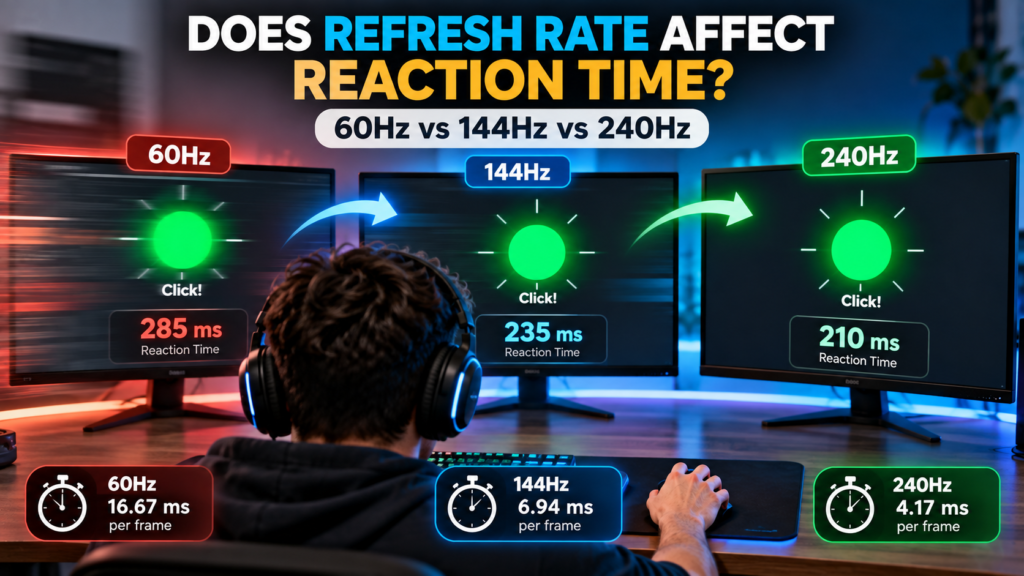
Yes, refresh rate can affect the reaction time shown by an online test because your monitor determines how quickly a new visual stimulus can appear on the screen. A higher refresh rate updates the image more frequently, reducing the time between frames.
However, switching from 60Hz to 144Hz does not suddenly make your brain react faster. It mainly reduces part of the display delay included in your measured score. You can try our Reaction Time Test to compare your results under the same conditions.
What Is Monitor Refresh Rate?
Refresh rate describes how many times a display can update its image each second. It is measured in hertz (Hz), so a 60Hz monitor can refresh up to 60 times per second, while a 144Hz monitor can refresh up to 144 times.
A higher refresh rate creates shorter intervals between frames. This can make motion look smoother and allows a newly generated visual signal to reach the screen sooner.
60Hz vs 144Hz vs 240Hz
The basic difference becomes clear when you calculate the time available for each refresh cycle.
| Refresh Rate | Time Between Frames |
|---|---|
| 60Hz | 16.67 ms |
| 120Hz | 8.33 ms |
| 144Hz | 6.94 ms |
| 240Hz | 4.17 ms |
| 360Hz | 2.78 ms |
At 60Hz, a new frame arrives roughly every 16.7 milliseconds. At 144Hz, that falls to about 6.9 ms, while a 240Hz display can update roughly every 4.2 ms.
How Does Refresh Rate Affect a Reaction Time Test?
When an online test changes from red to green, your browser may prepare that change between two display refreshes. The stimulus cannot physically become visible until the monitor presents an updated frame.
A higher-refresh display gives the system more opportunities each second to show the change. This can reduce some display-related delay and make repeated reaction-time measurements slightly more consistent.
Does Higher Refresh Rate Make Your Reaction Time Faster?
It can make your measured score faster, but that does not necessarily mean your biological reaction time has improved. Your eyes, nervous system, brain, and muscles are still performing the human part of the response.
The difference comes from reducing technology-related delay before you see the signal. This is why comparing scores from completely different displays can be misleading.
How Much Difference Can 60Hz vs 144Hz Make?
There is no rule saying that changing from 60Hz to 144Hz will improve every reaction-time score by a fixed number such as 10 ms. The signal can appear at different points within the monitor’s refresh cycle on each attempt.
The theoretical frame interval falls from 16.67 ms at 60Hz to 6.94 ms at 144Hz, but total measured latency also depends on the monitor itself, computer, browser, and input device.
Is 240Hz Better Than 144Hz?
A 240Hz display has a shorter frame interval than 144Hz, so technically it can present a new frame sooner. However, the improvement becomes progressively smaller as refresh rate increases.
Moving from 60Hz to 144Hz cuts the frame interval by almost 10 ms, while moving from 144Hz to 240Hz saves only about another 2.8 ms per frame. This is an example of diminishing returns.
Does Research Show a Difference?
A 2026 study involving 101 FPS players tested gameplay-related target acquisition at 60Hz, 144Hz, and 360Hz. Performance improved when moving away from 60Hz, but researchers did not find a significant performance advantage between the 144Hz and 360Hz conditions. (ScienceDirect)
Earlier research specifically examining simple reaction tasks across 60Hz, 120Hz, and 240Hz also reported that refresh-rate-related differences could affect measured reaction time. (Tokyo City University)
Refresh Rate Is Not the Same as Monitor Response Time
Refresh rate and pixel response time describe different things. Refresh rate tells you how frequently the monitor can update, while pixel response time describes how quickly pixels change from one state to another.
A 240Hz label therefore does not automatically mean that every 240Hz monitor has lower total latency than every 144Hz monitor. Display processing and panel performance also matter.
Higher Hz Does Not Guarantee Lower Input Lag
Refresh rate is only one part of the full latency chain. Research measuring real display systems has shown that monitors with the same refresh rate can have different system latencies, and a higher refresh rate does not automatically guarantee lower total delay. (PMC)
Other factors include:
- Monitor processing delay
- Pixel response time
- Computer frame rate
- Mouse or touchscreen latency
- Operating system processing
- Browser timing
For a deeper explanation, read How Accurate Is an Online Reaction Time Test?.
FPS and Refresh Rate Matter Together
A monitor can only display new frames when the computer provides them. Using a 240Hz monitor while a game runs at a very low frame rate will not provide the same experience as combining a high refresh rate with a consistently high frame rate.
For competitive gaming, the entire system matters: display, GPU, CPU, input device, frame rate, and network conditions. See our Reaction Time Test for Gamers for more on gaming performance.
Why Your Scores Change Between Devices
You may get 220 ms on one computer and 240 ms on another even when you feel equally alert. Different monitors and input devices can add different amounts of delay to the final measurement.
This is why hardware should remain consistent when tracking improvement. Our Phone vs PC Reaction Time guide explains how device and input differences can influence browser-test results.
Which Refresh Rate Is Best for Reaction Time Testing?
You do not need a 240Hz gaming monitor just to use an online reaction test. A 60Hz display can still provide useful results, especially when you compare repeated attempts on the same equipment.
A higher-refresh display may reduce measurement delay and variation, but consistency is more important than chasing the lowest possible number. Use the same monitor, browser, and input device when comparing progress.
Should You Compare 60Hz and 144Hz Scores?
You can compare them as an experiment, but do not assume the entire difference represents an improvement in your nervous system. Part of the score change may simply come from the faster display.
For meaningful personal tracking, compare multiple attempts using the same setup. If you want to understand whether your result is fast or average, see What Is a Good Reaction Time?.
Frequently Asked Questions
Does 144Hz improve reaction time?
144Hz can reduce display-related latency compared with 60Hz because frames are presented more frequently. It may improve the measured score, but it does not directly change your biological reaction speed.
Is 240Hz better than 144Hz for reaction time?
240Hz has a shorter frame interval, but the theoretical improvement from 144Hz to 240Hz is much smaller than the jump from 60Hz to 144Hz.
Can 60Hz give an accurate reaction time?
Yes, especially for personal comparisons made repeatedly on the same setup. The result simply includes the characteristics and latency of that display and input system.
Does refresh rate affect online reaction tests?
Yes. Because the visual stimulus must appear on your screen before you can react, display refresh timing can influence the recorded result.
Conclusion
Refresh rate can affect reaction time measurements, mainly by changing how quickly a visual stimulus can appear on your display. A 144Hz or 240Hz monitor updates more frequently than a 60Hz screen and can therefore reduce part of the display-related delay.
Higher refresh rate is not the whole story, though. Monitor processing, frame rate, input devices and browser latency also affect online results. For fair progress tracking, keep your hardware consistent and compare several attempts rather than one score.
Sources
Toth AJ, et al. (2026). Monitor refresh rate impacts FPS video gamers’ perceptions of display smoothness and target acquisition performance.
https://doi.org/10.1016/j.ssaho.2026.102774
Murakami K, Miyashita K, Miyachi H. A Study on the Relationship Between Refresh Rate of Display and Reaction Time of eSports.
https://research.tcu.ac.jp/en/publications/a-study-on-the-relationship-between-refresh-rate-of-display-and-r-2/
Saunders DR, Woods RL. Direct measurement of the system latency of gaze-contingent displays. Behavior Research Methods.
https://pmc.ncbi.nlm.nih.gov/articles/PMC4077667/
Related Guides
Want to measure your own reaction time? Try the free Reaction Time Test, then dig deeper with these guides: