
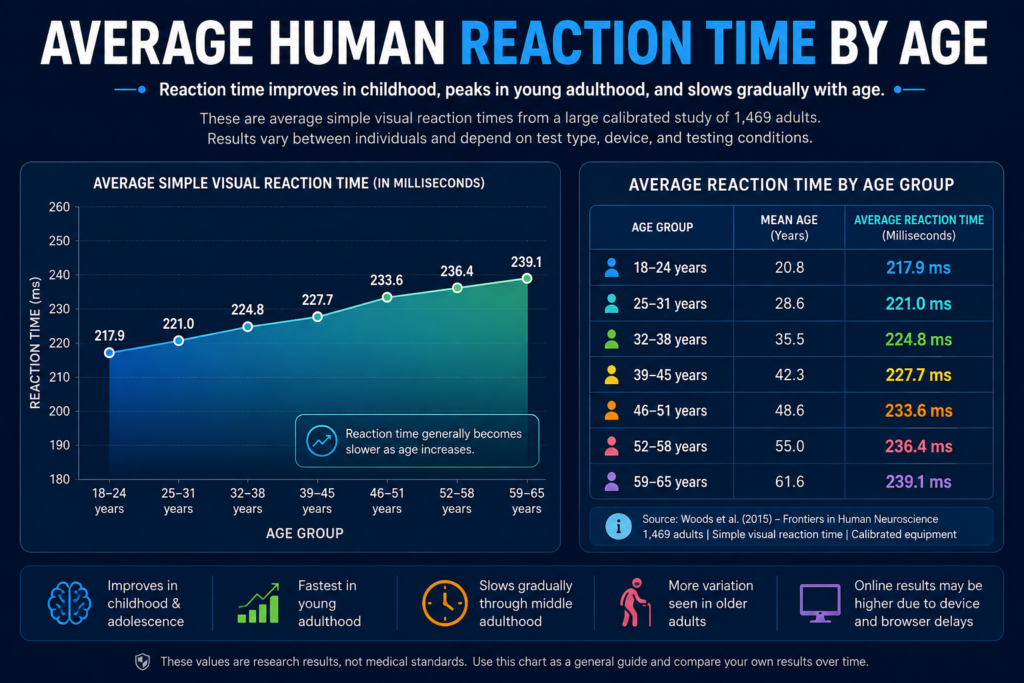
Human reaction time changes gradually across the lifespan. Response speed generally improves through childhood and adolescence, is often fastest in young adulthood, and then becomes slightly slower and more variable through middle and older adulthood.
There is no single “normal” reaction-time score for every person of a certain age. Sleep, focus, practice, health, device latency, browser performance, input method, and test design can all affect the number shown on screen.
Average Reaction Time by Age Chart
The following values come from a calibrated simple visual reaction-time study involving adults aged 18 to 65.
| Age Group | Mean Age | Average Simple Reaction Time |
|---|---|---|
| 18–24 years | 20.8 | 217.9 ms |
| 25–31 years | 28.6 | 221.0 ms |
| 32–38 years | 35.5 | 224.8 ms |
| 39–45 years | 42.3 | 227.7 ms |
| 46–51 years | 48.6 | 233.6 ms |
| 51–58 years | 55.0 | 236.4 ms |
| 59–65 years | 61.6 | 239.1 ms |
These figures show a gradual increase in simple reaction time across adulthood rather than a sudden slowdown at one particular age.
The same study estimated that its equipment added about 18 ms of delay. This is one reason browser-based scores can differ from calibrated laboratory results.
How Reaction Time Changes With Age
Reaction time does not suddenly become slow after a particular birthday. It changes gradually as attention, movement preparation, coordination, and motor response develop or change.
The size of the age difference also depends on the type of task. Simple one-response tests usually show smaller age differences than tasks requiring several possible decisions.
Reaction Time in Children
Young children generally respond more slowly than teenagers and adults because attention, motor coordination, movement control, and understanding of the task are still developing.
Performance can be influenced by:
- Age
- Attention span
- Understanding the instructions
- Hand size
- Device familiarity
- Motor coordination
- Motivation
- Test complexity
Research supports a general trend of faster responses as children get older, but there is no single browser-test number that should be considered normal for every child.
Online reaction tests should be used for casual interest only and not as a developmental or medical assessment.
Reaction Time in Teenagers
Reaction speed generally continues improving during adolescence as attention, coordination, and response control develop.
Teenagers may produce simple visual results close to young-adult levels, especially if they are familiar with computers, games, or fast screen-based tasks.
However, gaming experience or frequent testing can affect familiarity with the task. This means two teenagers of the same age can still record very different scores.
For a fair comparison, teenagers should complete several valid attempts and focus on their average rather than one unusually fast click.
Reaction Time in Young Adults
Young adulthood is commonly associated with some of the fastest average simple reaction times.
In the calibrated adult data above, participants aged 18–24 recorded an average of about 217.9 ms before hardware correction.
Young adults may benefit from:
- Fully developed motor coordination
- Fast movement initiation
- Strong processing speed
- Familiarity with digital devices
- Fewer age-related movement changes
Even so, a young adult can still record a slow result because of tiredness, distraction, unfamiliar equipment, or device delay.
Reaction Time in Middle-Aged Adults
Reaction time usually becomes gradually slower through middle adulthood rather than changing suddenly.
In the same study, average results increased from about 227.7 ms in the 39–45 age group to around 236.4 ms in the group with a mean age of 55.
This difference is measurable across a large group, but it is still relatively small compared with the differences that can occur between individual people and devices.
A middle-aged adult can therefore easily record a faster result than a younger person.
Reaction Time After Age 60
Adults over 60 may take slightly longer to respond and can show greater variation between attempts.
Age differences often become more noticeable when the task requires several choices rather than one simple response.
A simple visual test only requires:
See the signal → respond
A choice-reaction task may require:
See the signal → identify it → choose the correct action → respond
The extra decision-making step usually increases response time and can make age-related differences more noticeable.
A slower browser-test result by itself does not indicate poor health or reduced ability.
Why Does Reaction Time Become Slower With Age?
Age-related changes can involve several stages of the response process.
Movement Preparation
Before clicking, tapping, or pressing a key, the body must prepare the movement. This preparation can become slightly slower with age.
Motor Response
The movement itself can also take longer. In simple reaction tasks, part of the age-related difference may come from movement-related processes rather than only from noticing the signal.
Task Complexity
Age differences usually become larger when a person must choose between several responses, ignore irrelevant signals, or change rules during the task.
Speed–Accuracy Strategy
Some people respond more carefully to avoid mistakes. A cautious response may be slower while still being more accurate.
This is why a slower result is not always a worse result.
Why Online Age Charts Are Only Estimates
An online reaction-time score includes more than your biological response.
The displayed number can include delay from:
- Monitor refresh timing
- Browser processing
- Operating-system scheduling
- Mouse or keyboard input
- Touchscreen processing
- Background applications
- JavaScript timing
- Device performance
Because of these factors, a browser result should not be compared directly with a laboratory average as if both measurements were identical.
For more detail about these technical differences, read How Accurate Is an Online Reaction Time Test?.
What Is a Good Reaction Time for Your Age?
There is no universal score that separates “good” and “bad” reaction time at every age.
A better approach is to use three comparisons.
1. Compare With a Broad Age Range
Use age-based charts to understand general trends rather than treating them as strict standards.
2. Compare With Your Own Results
Your personal baseline is often more useful than comparing yourself with strangers using different devices.
Track:
- Five-attempt average
- Median
- Best result
- Slowest result
- Consistency
- Device used
3. Compare Multiple Sessions
Repeat the test on different days under similar conditions.
A stable personal average is more useful than one unusually fast or slow click.
For general score interpretation, read What Is a Good Reaction Time? Average Scores Explained.
Desktop vs Mobile Age Comparisons
Desktop and mobile scores should not be mixed when comparing reaction time by age.
A desktop setup may use a physical mouse, fixed hand position, and a higher-refresh-rate display. A phone uses touchscreen processing, finger movement, mobile browser behavior, and different hardware.
Neither score is automatically wrong.
They simply come from different testing conditions.
For progress tracking, use the same device whenever possible.
Disclosure: Some of the links in this article are affiliate links. If you buy through them, we may earn a small commission at no extra cost to you — and as an Amazon Associate, we earn from qualifying purchases.
Comparing scores across ages only makes sense on the same gear — a gaming mouse on Amazon keeps the input side consistent.
How to Measure Your Reaction Time Fairly
Use a consistent testing process:
- Use the same computer or phone
- Use the same mouse, keyboard, or touchscreen
- Close unnecessary programs
- Remove distractions
- Complete one practice attempt
- Complete five valid recorded attempts
- Do not predict the signal
- Compare average and median
- Retest at a similar time
- Keep the same device and browser
These steps cannot remove every technical delay, but they make repeated comparisons more meaningful.
Average, Median, or Best Score?
Your average uses every valid attempt and provides a useful summary of the complete session.
Your median is the middle value after the results are arranged from fastest to slowest. It is less affected by one unusually fast or slow result.
Your best score represents your fastest valid attempt, but it may not represent your normal reaction speed.
For age comparisons, your average and median are generally more useful than your single fastest result.
Test Your Reaction Time
Use the free Reaction Time Test to complete five visual-response attempts.
You can review:
- Average
- Median
- Best result
- Slowest result
- Consistency
- Attempt history
For the fairest comparison, use the same device and repeat the test under similar conditions.
Frequently Asked Questions
What is the average human reaction time by age?
Reaction time generally improves from childhood to young adulthood and then becomes gradually slower. In one calibrated adult study, average simple visual reaction time increased from about 218 ms at ages 18–24 to about 239 ms at ages 59–65.
At what age is reaction time fastest?
Reaction time is generally fastest in young adulthood, although the exact peak depends on the person, task, and testing method.
What is a good reaction time for a teenager?
Many teenagers can produce results close to young-adult levels on simple visual tests. Several attempts on the same device are more useful than one universal teenage benchmark.
What is a good reaction time for an adult?
A simple visual result around 200–250 ms is generally fast in calibrated testing. Online browser results can be higher because device and software delays are included.
Does reaction time become slower after 30?
Reaction time can become gradually slower across adulthood, but the average change from one year to the next is small.
What is the average reaction time after age 60?
In one calibrated simple visual study, adults aged 59–65 averaged about 239 ms before equipment-delay correction.
Can an older person have faster reactions than a younger person?
Yes. Age affects group averages, but individual results vary widely because of practice, focus, fitness, sleep, device conditions, and other factors.
How many attempts should I complete?
Complete at least five valid attempts. Use the average and median rather than relying on one fastest click.
Is reaction time a medical test?
No. A browser reaction test is intended for general performance measurement and personal comparison, not medical diagnosis.
Conclusion
Human reaction time generally improves through childhood and adolescence, is often fastest in young adulthood, and then becomes gradually slower across adulthood. In one calibrated adult dataset, simple visual averages increased from about 218 ms at ages 18–24 to around 239 ms at ages 59–65.
Age charts are best used as general educational context rather than strict standards. For meaningful progress tracking, complete several attempts, use the same setup, and compare your own average and median over time.
Source
The age-based reaction-time data in this article is based on the following published research study:
Woods DL, Wyma JM, Yund EW, Herron TJ, Reed B. (2015). Factors influencing the latency of simple reaction time. Frontiers in Human Neuroscience, 9:131.
https://doi.org/10.3389/fnhum.2015.00131