
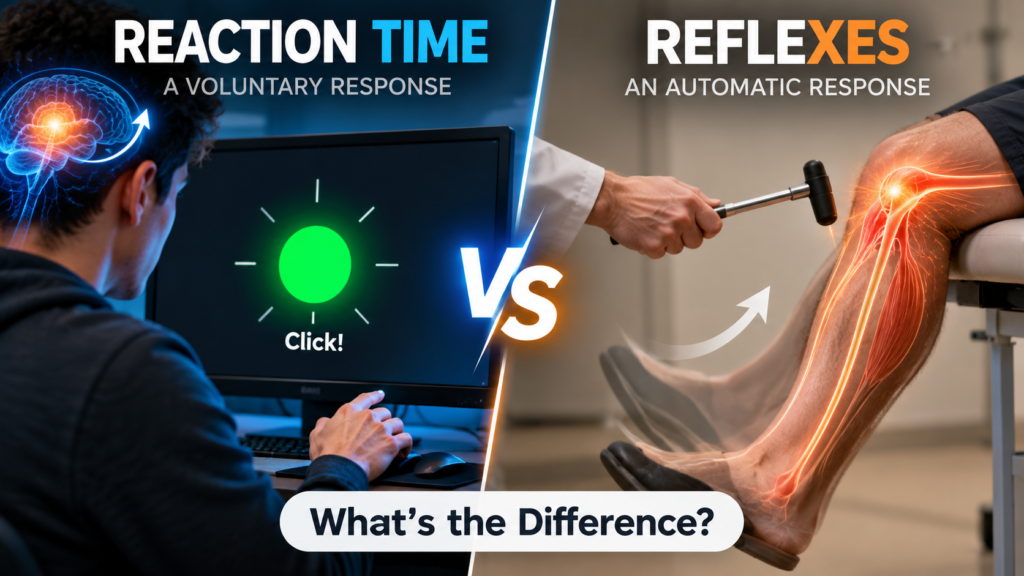
Reaction time and reflexes are often used as if they mean the same thing, but they describe different nervous-system responses. Reaction time usually involves noticing a stimulus and starting a voluntary action, while a reflex is an automatic response that does not require a conscious decision.
This difference matters when using an online “reflex test.” A wait-for-green browser test normally measures simple visual reaction time, not a clinical reflex. You can try our Reaction Time Test to measure how quickly you respond to a visual signal.
What Is Reaction Time?
Reaction time is the interval between a stimulus appearing and the start of a voluntary response. In a simple test, the screen may change color, and you click as soon as you see it. The required action is already known before the signal appears.
Even a simple reaction involves several stages, including detecting the stimulus, processing it, preparing the movement, and starting the response. This is why reaction time reflects more than muscle speed alone and can vary between people and testing conditions.
What Is a Reflex?
A reflex is an automatic and involuntary response triggered by a particular stimulus. Common examples include the knee-jerk reflex and the withdrawal reflex that helps move a body part away from something painful.
Different reflexes use different neural pathways. Some are organized mainly through the spinal cord, while others may involve the brainstem or more complex circuits. Therefore, “reflex” is a neurological term, not simply another word for a fast reaction.
Reaction Time vs Reflexes: Key Differences
| Feature | Reaction Time | Reflex |
|---|---|---|
| Response | Usually voluntary | Automatic and involuntary |
| Example | Clicking when screen turns green | Knee jerk after tendon tap |
| Conscious action | Usually involved | Not required for basic reflex |
| Browser test | Commonly measurable | Clinical reflexes are not |
| Measurement | Usually in milliseconds | Depends on the specific reflex |
The biggest difference is control. Reaction time describes how quickly you begin an intended action after detecting a signal. A reflex describes an automatic nervous-system response produced without consciously selecting the movement.
Is an Online Reaction Time Test a Reflex Test?
Usually, no. A browser test that asks you to wait for green and then click is a simple visual reaction-time task. You know what action to perform beforehand, but you still need to detect the signal and intentionally begin the click.
Websites sometimes use “reflex test” casually because the phrase is familiar to users. Scientifically, however, a reaction time test is more accurate. A score such as 220 ms or 280 ms does not tell you whether your clinical reflexes are normal.
Are Reflexes Faster Than Reaction Time?
Some reflexes can happen very quickly because they are automatic and may use short neural pathways. For example, a withdrawal reflex can activate spinal motor pathways without waiting for a deliberate movement decision.
However, there is no universal rule that every reflex is faster than every voluntary reaction. A knee reflex, blink reflex, withdrawal reflex, and visual mouse-click reaction use different pathways and measurement methods, so their numbers should not be directly compared.
Why Can Reaction-Time Scores Change?
Your reaction-time result can change even when your actual ability has not changed much. Attention, fatigue, sleep, practice, hand position, anticipation, and familiarity with the test can all influence how quickly you respond in a particular session.
Your device can also affect the result. Display refresh rate, browser timing, mouse or keyboard input, and touchscreen latency may add delay. Read How Accurate Is an Online Reaction Time Test? for a deeper explanation.
What Is a Good Reaction Time?
There is no single perfect reaction-time score for every person and every device. Browser tests are most useful when you compare several attempts under similar conditions rather than treating one unusually fast result as your true ability.
If you are trying to understand results such as 200 ms, 250 ms, or 300 ms, read What Is a Good Reaction Time?. Comparing your average or median is usually more useful than judging one click.
Why Do Gamers Say “Fast Reflexes”?
Gamers often use “fast reflexes” to describe quick responses, but many gaming actions are actually voluntary reaction tasks. A player may need to see an opponent, recognize the situation, choose an action, aim, and then press a key or mouse button.
That process includes perception, decision-making, anticipation, and movement. Basic reaction speed still matters, but it is only one part of gaming performance. Our Reaction Time Test for Gamers explains this in more detail.
Can You Improve Reaction Time?
Reaction-time performance can improve through practice, better attention, familiarity with a task, and consistent testing conditions. Repeating the same task may also reduce hesitation because you already understand what signal to expect and how to respond.
If you want to improve your browser-test performance, focus on consistent sleep, several attempts, comfortable hand placement, and comparing averages. See How to Improve Your Reaction Time Test Score for practical methods.
Reaction Time Is Not a Medical Reflex Test
An online reaction-time test measures performance on a visual response task. It is useful for tracking personal results and comparing repeated attempts, but it should not be used to diagnose problems with your nervous system or clinical reflexes.
Doctors test specific reflexes using established examination methods. For example, the patellar reflex is produced by tapping the patellar tendon and observing the automatic muscle response through a spinal reflex pathway.
Frequently Asked Questions
Is reaction time the same as reflex speed?
No. Reaction time generally measures how quickly you begin a voluntary response after a stimulus. A reflex is an automatic, involuntary response produced through a particular neural pathway.
Does an online reflex test measure real reflexes?
Most online “reflex tests” actually measure visual reaction time. They do not test clinical tendon, withdrawal, or neurological reflexes in the same way a medical examination does.
Is 200 ms a reflex time?
A 200 ms browser result is better described as a reaction-time score. It represents the delay between the visual signal and your recorded click or tap, including some possible device delay.
Can a fast reaction time prove that my reflexes are good?
No. A fast browser score only shows strong performance on that particular reaction task. Clinical reflexes are measured and interpreted differently.
Conclusion
Reaction time and reflexes both involve responses to stimuli, but they are not the same thing. Reaction time usually involves detecting a signal and beginning a voluntary action, while a reflex is an automatic response produced through a specific nervous-system pathway.
For an online wait-for-green test, reaction time is the correct term. Use several attempts, keep your testing conditions consistent, and treat the result as a performance measurement rather than a medical reflex test.
Sources
Central Nervous System Physiology — Reaction Time
Reaction-time definition and processing stages.
NCBI StatPearls — Physiology, Withdrawal Response
Reflex definition and spinal withdrawal pathway.
NCBI StatPearls — Neuroanatomy, Spinal Cord Myotatic Reflex
Spinal reflex arc and patellar reflex physiology.