
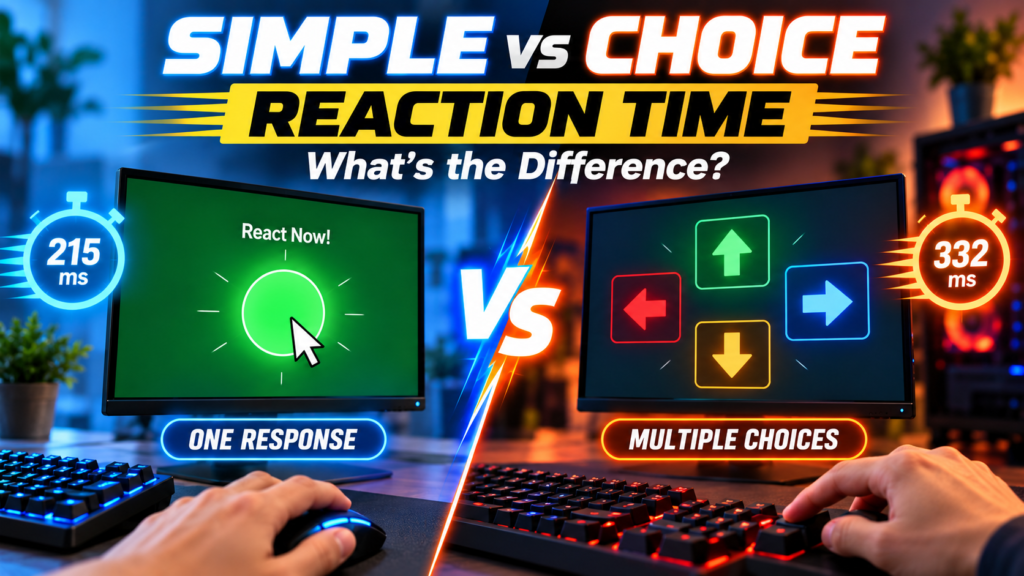
Reaction time tests do not all measure the same thing. A simple reaction time task asks you to respond to one known signal, while a choice reaction time task makes you identify the signal and select the correct response.
That extra decision step is why choice reaction time is usually slower. To measure basic visual response speed, try our Reaction Time Test and compare several attempts.
What Is Simple Reaction Time?
Simple reaction time measures how quickly you respond when there is one expected stimulus and one known response. For example, the screen turns green and your only job is to click as quickly as possible.
Because you already know what action to take, little response selection is needed after the signal appears. Scientific literature defines simple reaction time as the interval between a single stimulus and the start of the required movement.
What Is Choice Reaction Time?
Choice reaction time includes two or more possible stimuli with different possible responses. You must identify what happened, select the correct action, and then begin your movement.
For example, you might press the left key when a blue circle appears and the right key when a red circle appears. The response cannot be fully selected until you know which stimulus was shown.
Simple vs Choice Reaction Time: Key Differences
| Feature | Simple Reaction Time | Choice Reaction Time |
|---|---|---|
| Stimuli | One expected stimulus | Two or more possible stimuli |
| Responses | One known response | Different possible responses |
| Decision step | Minimal | Required |
| Typical result | Usually faster | Usually slower |
| Example | Click when screen turns green | Press a different key for each color |
| Main demand | Detection and response | Detection, selection and response |
A choice task adds uncertainty and response selection, so it involves more decision processing than a simple wait-for-green test.
Why Is Choice Reaction Time Usually Slower?
Choice tasks normally take longer because your brain has more information to process before movement begins. Instead of only detecting a signal, you also need to identify it and connect it with the correct response.
This difference is closely related to the Hick-Hyman law. Research shows that choice reaction time generally increases as the number or uncertainty of possible stimulus-response alternatives increases.
What Is the Hick-Hyman Law?
The Hick-Hyman law describes how response time changes as the amount of choice in a task increases. In general, more possible options create more uncertainty, so selecting the correct response takes longer.
The increase is not a fixed number of milliseconds for every extra option. Practice, stimulus-response compatibility, and task design can all affect the relationship.
Simple Reaction Time Example
A standard online reaction test is a good example of a simple reaction-time task. You wait for one visual signal, such as a screen changing color, and perform the same response every time.
You still have to detect the change and start your movement, but there is no need to choose between several possible actions after the stimulus appears.
Choice Reaction Time Example
Imagine a test showing one of four arrows: left, right, up, or down. Your job is to press the matching arrow key as quickly and accurately as possible.
You must recognize the direction, select the corresponding key, and avoid pressing the wrong one. That additional response-selection stage is what separates the task from a simple reaction test.
Which Type Does an Online Reaction Time Test Measure?
Most wait-for-green browser tests measure simple visual reaction time. You already know what signal to watch for and what action you will perform before the test begins.
This makes the format useful for tracking basic response speed under similar conditions. However, browser, display, and input-device delay can still influence the recorded number, as explained in our Online Reaction Time Test Accuracy guide.
How Much Slower Is Choice Reaction Time?
There is no universal difference that applies to every person or every test. The gap depends on the number of choices, how similar the options are, how much you have practiced and how the task is designed.
Because of this, a choice-reaction score should not be judged using the same standard as a simple reaction score. The two tests require different amounts of processing before the response begins.
What Affects Both Types of Reaction Time?
Simple and choice reaction time can both change between sessions. Your result reflects your performance on that particular task and under those particular conditions, rather than being one permanent number.
Common influences include:
- Attention and distraction
- Sleep and fatigue
- Practice and familiarity
- Age
- Device and input latency
- Hand position
- Speed-versus-accuracy strategy
If you are trying to understand whether your basic result is fast, average or slow, see What a Good Reaction Time Is?.
Which Type Matters More for Gaming?
Simple reaction time is useful for measuring basic visual response speed, but many real gaming situations are closer to choice reaction tasks. A player may need to spot an enemy, identify the situation, select an action, and then execute it.
Gaming also depends on anticipation, accuracy, decision-making, and experience. Our Reaction Time Test for Gamers explains why one browser score cannot represent complete in-game performance.
Can You Improve Simple and Choice Reaction Time?
Practice can improve performance on reaction-time tasks, especially as you become familiar with the stimulus and response rules. Good sleep, attention, and consistent testing conditions can also make results more stable.
When tracking progress, compare averages from the same type of test. Mixing simple and choice reaction-time scores can be misleading because the two tasks place different demands on your brain.
Frequently Asked Questions
Is simple reaction time always faster than choice reaction time?
Simple reaction time is generally faster because the required response is already known. The exact difference still varies with the person, task, practice, equipment, and number of choices.
Is a wait-for-green test simple or choice reaction time?
It is normally a simple reaction-time task. There is one expected signal and one required response: click or tap when the signal appears.
Does adding more choices make reaction time slower?
In many choice tasks, reaction time increases as the number or uncertainty of possible responses increases. This relationship is commonly described by the Hick-Hyman law.
Can I compare a simple score with a choice reaction score?
You can compare them for interest, but they should not be treated as equivalent measurements. Choice reaction time includes additional identification and response-selection demands.
Conclusion
Simple and choice reaction time measure related but different abilities. Simple reaction time uses one known stimulus and one response, while choice reaction time requires you to identify the stimulus and select from multiple possible actions.
For a basic browser benchmark, a simple reaction test provides a cleaner measurement. Choice reaction tasks become more useful when you want to measure decision-making speed along with response speed.
Sources
Lalonde R, Botez-Marquard T. The neurobiological basis of movement initiation. Reviews in the Neurosciences. 1997. DOI: 10.1515/revneuro.1997.8.1.35
Proctor RW, Schneider DW. Hick’s law for choice reaction time: A review. Quarterly Journal of Experimental Psychology. 2018. DOI: 10.1080/17470218.2017.1322622
Wright CE, Marino VF, Chubb C, Mann D. A model of the uncertainty effects in choice reaction time that includes a major contribution from effector selection. Psychological Review. 2019. DOI: 10.1037/rev0000146