
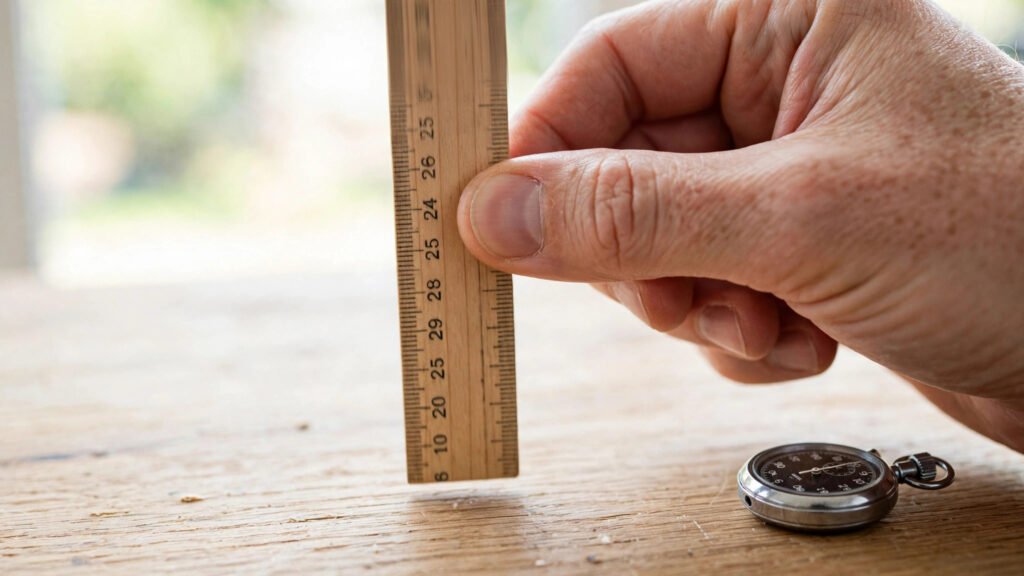
Want to measure your reaction time without a screen nearby? The ruler drop test is the classic way. All you need is a ruler, a partner, and about five minutes — and a little high-school physics turns the distance the ruler falls into your actual reaction time in milliseconds.
In this guide, you’ll learn exactly how to run the ruler drop test, score it with a simple conversion table, and use it to track your reaction speed over time.
What Is the Ruler Drop Test?
The ruler drop test is a simple, equipment-free way to measure your reaction time. One person holds a ruler vertically above your open hand and lets go without warning. You catch it as fast as you can, and the distance it fell tells you how quickly your brain and hand responded. The shorter the fall, the faster your reaction time.
Because it involves grabbing a real, physical object, it measures a slightly different kind of response than clicking a mouse when a screen changes color. If you already know what a good reaction time is, you’ll have a useful baseline to compare against.
What You Need
- A ruler at least 30 cm (12 inches) long — a wooden or plastic school ruler is perfect. A tape measure also works.
- A partner to drop the ruler for you.
- A chair or table to rest your arm on (recommended for consistency).
- A pen and paper, or your phone, to record your results.
How to Do the Ruler Drop Test: Step by Step
Follow these steps carefully — consistent technique is what makes the results meaningful, especially if you plan to test again in a few weeks.
- Sit comfortably. Rest your forearm on a table so your wrist and hand hang over the edge. Keep your hand open, thumb and index finger about 3–4 cm apart, ready to pinch.
- Position the ruler. Your partner holds the ruler vertically with its zero mark level with the top of your thumb, so every attempt starts from the same point.
- Focus on the ruler. Watch the middle of the ruler, not your partner’s hand. They should hold it perfectly still.
- Wait for the drop. After a random 2–5 second delay, your partner releases the ruler without warning — no countdowns, no “ready… go.”
- Catch it. Pinch the ruler between your thumb and index finger as fast as you can. Don’t close your whole fist or sweep downward.
- Read the distance. Note where the top of your thumb is now, in centimeters, rounded to the nearest 0.5 cm.
- Repeat 5 times. Rest about a minute between attempts. Throw out any attempt where you fumbled or your partner gave it away early.
The Dropper’s Rules
If you’re dropping the ruler, your job matters just as much. Keep the ruler perfectly still before the drop — any wobble is a visual cue. Vary the delay each time so your partner can’t learn your rhythm, and never fake a drop or speak as you release. A clean, silent release is the only fair one.
How to Score: The Ruler Distance to Reaction Time Table
Here’s the physics bit, made simple. A falling object accelerates at gravity’s rate (9.81 m/s²), so the distance it falls is directly tied to the time it was falling: d = ½·g·t². In other words, your reaction time is the exact moment between release and your catch — and the distance the ruler fell tells us precisely how long that took.
Use this table to convert your caught distance into reaction time in milliseconds. Note the math isn’t linear: a falling object accelerates, so catching the ruler early makes a bigger difference than it looks.
| Ruler distance caught | Reaction time (ms) | What it means |
|---|---|---|
| 5 cm | ≈ 101 ms | Exceptional — elite athlete territory |
| 10 cm | ≈ 143 ms | Excellent — well above average |
| 15 cm | ≈ 175 ms | Very good — faster than most people |
| 20 cm | ≈ 202 ms | Good — solid average range |
| 25 cm | ≈ 226 ms | Average — typical adult score |
| 30 cm | ≈ 247 ms | Below average — room to improve |
| 35 cm | ≈ 267 ms | Slow — worth training and retesting |
Note the math isn’t linear: the gap between 5 and 10 cm is about 42 ms, but between 25 and 30 cm it’s only about 21 ms. That’s because a falling object speeds up as it drops — so catching it early makes a bigger difference than it looks.
How to Average Your Attempts
One catch doesn’t tell you much — anyone can get lucky or be distracted. Here’s a scoring method that coaches actually use:
- Do 5 valid attempts and write down each distance.
- Cross out your best and worst attempts to remove flukes.
- Average the remaining three, then convert to milliseconds with the table.
Example: attempts of 12, 18, 15, 21, and 14 cm → drop 12 and 21 → average of 18 + 15 + 14 ≈ 15.7 cm → about 179 ms. Keep a simple log with the date, average distance, and converted time, and retest every 2–4 weeks under the same conditions to track real progress.
Ruler Drop Test vs. Online Reaction Tests
Online tests measure a simple reaction: see a visual cue, click. The ruler drop test adds real-world complexity — you see the ruler start to fall, then coordinate a pinch movement in 3D space. Because of that extra coordination, ruler drop scores usually run 20–50 ms slower than the same person’s online click score.
That’s not a flaw. The ruler test is closer to real-life reactions like catching a dropped phone. For a deeper look at screen-based tests and what can skew them, see our guide on online reaction time test accuracy.
Context matters too. Reaction time shifts with age — young adults tend to be fastest, with gradual slowdown from middle age onward. Judge your score against expectations for your age group, not against your friend’s.
Tips for Accurate Results
- Warm up. Do 2–3 practice catches first — cold, stiff fingers react slower. Practice runs don’t count toward your score.
- Stay relaxed. Tense shoulders slow you down. Shake out your hands between attempts.
- Don’t watch the dropper’s hand. Watch the ruler itself — looking at their fingers gives you early cues and inflates your score.
- Keep the same setup. Same chair height, arm position, and zero alignment every time. Small geometry changes skew results.
- Test when alert. Reaction time is noticeably worse when tired — mid-morning or early afternoon gives your truest baseline.
- Randomize the delay. The dropper should wait 2–5 seconds before each release. If you can predict the drop, you’re not measuring reaction anymore.
Fun Variations to Try
Dominant vs. Non-Dominant Hand
Run the test with your dominant hand, then switch. Most people are 10–30 ms slower with their non-dominant hand — a fun gap to close with practice.
The Distraction Test
Have your partner talk to you or ask simple questions (count backward from 20) while you wait for the drop. Split attention almost always worsens your score — a vivid demonstration of why texting while driving is dangerous.
Competition Mode
Take turns as dropper and catcher, best of five. Competition adds adrenaline, which can genuinely sharpen your scores — or make them worse if you get twitchy.
Eyes-Closed Start
Start with your eyes closed and have your partner say “now” as they release. This measures pure audio-to-motor reaction. (Expect worse scores — that’s the point.)
Tracking Improvement Over Weeks
The ruler drop test really shines as a before-and-after tool. Reaction time is trainable — better sleep, regular exercise, and focused practice all move the needle. For a structured plan, see our guide on how to improve your reaction time test score.
Set a baseline: test on three different days and average the three daily scores. Then train for 4–6 weeks and retest. A realistic improvement is 10–30 ms — in reaction-time terms, that’s significant. Log the date, time of day, sleep hours, and caffeine each session; after a month you’ll spot patterns, like scoring best on days you slept 8 hours.
Frequently Asked Questions
Is the ruler drop test accurate?
Yes — within its limits. The physics conversion is exact; imprecision comes from technique (a moving dropper, an inconsistent start position), not the method itself. Follow the steps carefully and your scores will be consistent enough to track real improvement.
What is a good ruler drop test score?
For adults, catching the ruler at 20–25 cm (roughly 200–230 ms) is average. Under 15 cm (about 175 ms) is very good, and under 10 cm (about 143 ms) is exceptional. Teenagers and fast-reaction athletes often score under 15 cm.
Can I do the ruler drop test alone?
Not reliably. You can’t drop the ruler and be genuinely surprised by the drop at the same time — you’ll anticipate it and inflate your score. You need a partner, or a mechanical release rigged with a clothespin and string.
Why is my ruler drop score slower than my online test score?
That’s normal. Online tests measure a simple finger click; the ruler test adds reaching and pinching — more coordination, more milliseconds. Most people score 20–50 ms slower on the ruler test. Compare ruler scores to ruler scores, not screen scores.
How often should I retest?
Every 2–4 weeks is ideal. Test too often and daily noise (sleep, caffeine, mood) drowns out the trend. Keep conditions consistent — same time of day, same partner, same chair — and you’ll see your true trajectory.
Conclusion
The ruler drop test proves you don’t need an app or a screen to measure your reaction time — just a ruler, a partner, and a little physics. It’s quick, it’s surprisingly accurate, and it gives you a number you can actually improve over time. Grab a ruler this week, establish your baseline with five clean attempts, and retest in a month. You might be surprised how much faster your hands can get — and you’ll have the numbers to prove it.