
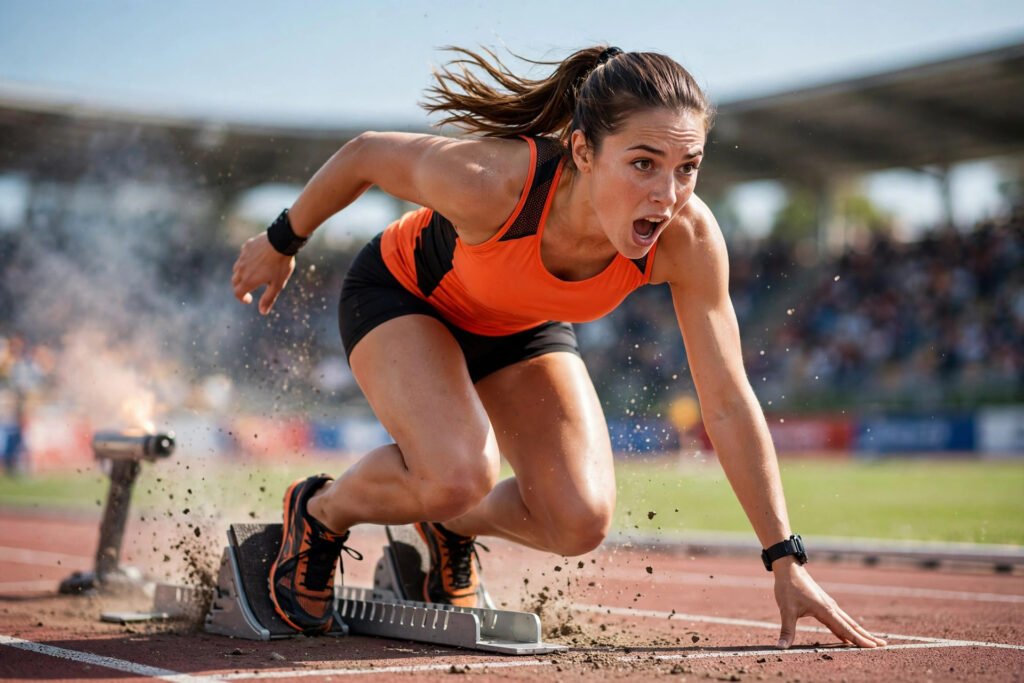
Every athlete knows the feeling: the starter’s gun, the serve flying toward you, the opponent’s feint that leaves you a half-step behind. Winning is rarely about raw speed alone — it is about how quickly you notice a signal, decide what it means, and move. A reaction time test gives athletes a simple, repeatable way to measure that process and, used properly, to train it.
This guide explains how reaction time works in sport, how to test it reliably, what counts as a good score for athletes, and which drills transfer to competition. All score ranges here are approximate guides, not medical standards.
Simple Reaction vs Choice Reaction in Sport
Not all reactions are the same, and the difference matters for training. A simple reaction involves one signal and one response: the gun fires, you sprint. A choice reaction involves several possible signals and several possible responses: the tennis serve could go wide, down the middle, or into the body, and you must read it and move the right way.
Simple reaction is usually faster, because there is no decision to make. Choice reaction is slower, because the brain must identify the signal and select a response before moving. Most sports depend far more on choice reaction — which is why a fast score on a basic light test does not automatically make someone a great goalkeeper or boxer.
A third layer is anticipation. Elite athletes read early cues — a server’s shoulder rotation, a striker’s hip position, a boxer’s weight shift — and start moving before the decisive moment. Anticipation is trainable, and it often matters more than shaving a few milliseconds off a raw test score.
Understanding the difference between reaction time and reflexes helps here too. Reflexes are automatic, involuntary responses; sport reactions are learned responses involving perception, decision-making, and trained movement.
How to Test Reliably
A reaction time test is only useful if the results are comparable from one session to the next. Random, one-off scores tell you very little. Follow these principles to get numbers you can trust.
Use the Same Device Every Time
Different phones, keyboards, and mice have different input delays, and screen refresh rates vary. A score of 230 milliseconds on one device might read as 260 milliseconds on another, with no change in the athlete at all. Pick one device, browser, and input method for every session; if you change devices, start a new baseline.
Take Multiple Attempts
A single attempt is noisy: distraction, a mistimed click, or a moment of fatigue can distort it completely. Take at least five attempts per session, ideally ten, and discard obvious outliers. Consistency is itself a useful signal: a tight cluster suggests a stable, focused athlete, while a wide spread may point to lapses in concentration.
Best Score vs Average Score
Your best score shows peak capability; your average (or median) shows typical performance — what actually shows up in competition. For tracking progress, the median of ten attempts is the most honest metric: it resists distortion from one lucky or bad click. Record both, but judge improvement by the median.
Test Under Consistent Conditions
Test at a similar time of day, after a similar warm-up, in a quiet environment — and not straight after an exhausting session if you want a baseline. If you want to improve your reaction time test score, measure first, train for several weeks, then re-test under the same conditions.
Reaction Demands by Sport
Different sports stress different parts of the reaction chain. A sprinter needs an explosive simple reaction to a sound; a goalkeeper needs rapid choice reactions under pressure; a boxer needs anticipation at close range. The table below compares the demands for several sports.
| Sport | Main Reaction Type | Key Stimulus | Training Emphasis |
|---|---|---|---|
| Sprinting (100m) | Simple reaction | Starter’s gun | Start drills, gun-signal practice, explosive first steps |
| Football goalkeeping | Choice reaction | Ball flight, striker’s body shape | Shot-stopping drills, reading shooters, dive timing |
| Tennis | Choice reaction and anticipation | Serve direction, spin, opponent positioning | Return-of-serve practice, split-step timing, cue reading |
| Boxing | Choice reaction and anticipation | Punches, feints, weight shifts | Pad work, slip and counter drills, sparring reads |
| Table tennis | Choice reaction | Ball speed and spin at close range | Fast rally drills, spin recognition, footwork |
| Esports (reaction-based titles) | Choice reaction | On-screen movement, sound cues | Aim trainers, scenario drills, consistent hardware setup |
The more open and unpredictable the sport, the more choice reaction and anticipation matter relative to raw simple-reaction speed — so training should match the sport, not just the test.
Training Drills That Transfer to Sport
General reaction drills can help, but drills that mimic your sport’s actual cues transfer far better. Use the ideas below as a starting point and adapt them to your discipline.
Visual Cue Drills
A coach can hold up coloured cards, point left or right, or drop a ball without warning, and the athlete must react with a pre-agreed movement — sprint, sidestep, catch, or block. Vary the signal and the response so the athlete practises choice reaction, not just one rehearsed movement. Reaction balls, which bounce unpredictably, are a simple tool for field and court athletes.
Anticipation Drills
Anticipation is built by studying opponents, not by clicking faster. Tennis players can practise reading serves from video, pausing just before contact and predicting the direction. Goalkeepers can study penalty takers’ run-ups; boxers can drill against partners who throw feints. Good anticipation is educated prediction, and it improves with deliberate exposure to real cues.
Agility and Change-of-Direction Drills
Reaction time means little if the body cannot move quickly once the decision is made. Ladder drills, cone drills with a coach’s random call, and small-sided games combine perception with explosive movement. The key detail is unpredictability: a drill where the direction is signalled at the last moment trains reaction plus speed together. Keep sessions short — reaction training works best when the athlete is fresh, not exhausted.
Fit the Drill to the Sport
A sprinter gains little from a table-tennis rally drill, and a goalkeeper gains little from gun-start practice. Match the stimulus, the response, and the time pressure to your sport, then re-test periodically to check whether general reaction speed is improving alongside sport-specific performance.
Sleep, Caffeine, and Fatigue
Sleep is the biggest factor: even one night of short or poor-quality sleep tends to slow reactions and increase variability, while well-rested athletes test faster and more consistently. Caffeine can sharpen alertness, especially when tired, but the effect depends on dose, timing, and tolerance — and too much can increase jitteriness and hurt fine control. Fatigue from hard training dulls reactions similarly, which is why testing after a gruelling session usually produces worse numbers than testing fresh.
For a deeper look, see this guide on how sleep and caffeine affect reaction time. The practical takeaway: protect sleep during competition weeks, use caffeine strategically, and compare scores only between sessions in a similar state of rest and fatigue.
What Counts as a Good Score for Athletes?
There is no single official standard, and scores vary with device, test design, age, and sport. For a simple visual reaction test (click or tap when a light changes), the general adult population typically averages around 250 to 300 milliseconds. Trained athletes often average roughly 200 to 250 milliseconds, with the fastest sprinters, racket-sport players, and combat athletes sometimes dipping below 200 milliseconds on a good day.
Context matters more than the raw number. A goalkeeper averaging 230 milliseconds who reads shooters brilliantly will outperform one averaging 200 milliseconds who dives the wrong way. A sprinter’s gun-reaction time in competition — often around 120 to 180 milliseconds for elite starters — differs from a screen test, because the stimulus is auditory and the response is a full-body start, not a mouse click.
If you are wondering what is a good reaction time in general, the athlete ranges above sit at the faster end of the population curve. Do not chase a single magic number — track your own median, and judge progress by whether your sport performance is improving alongside the test score.
Frequently Asked Questions
Does a faster reaction time test score make me a better athlete?
Not by itself. A fast simple-reaction score shows quick basic processing, but sport also demands anticipation, decision-making, technique, and physical speed. The test is most useful as one training metric among several, not as a talent verdict. Athletes who combine a solid test score with strong sport-specific anticipation usually perform best.
How often should athletes take a reaction time test?
Once or twice a week is plenty. Testing daily adds noise, while testing monthly may miss a training block’s effects. Keep device, time, and conditions consistent, and record the median of about ten attempts each session.
Can reaction time actually be improved, or is it fixed?
It can be improved, within limits. Training, better sleep, reduced fatigue, and sport-specific anticipation practice all tend to move scores in the right direction. Genetics and age set a rough ceiling, but most athletes have room to improve through consistent, sport-relevant training.
Should athletes use their best score or their average score?
Use the median or average for tracking progress, and note the best score as a peak marker. The median reflects typical performance under pressure, which is what competition demands. A single fast click proves little; a steadily improving median across weeks proves a lot.
Do reaction time tests help esports players too?
Yes, with the same caveats. Esports players rely heavily on choice reaction to on-screen cues, and consistent hardware matters even more because input delay directly affects scores. Aim trainers complement a basic test, but in-game decision-making and game sense remain decisive at higher levels.
Conclusion
A reaction time test is a cheap, quick, and surprisingly honest training tool — provided it is used properly. Test on the same device, take multiple attempts, track your median, and train the reactions your sport actually demands: gun starts for sprinters, cue reading for goalkeepers and racket players, anticipation for boxers and esports athletes. Protect your sleep and use caffeine wisely. The real goal is not a faster click — it is a faster first step, a better-timed dive, a cleaner return.